
Daily Trust: A Smarter Path to Identity Governance
PART TWO
One decision tree. Two paths. And a growing gap between what’s deployed and what’s actually governed.
When it comes to identity governance, few things bring more clarity (or more confusion) than choosing between “Light IGA” and “Full IGA.”
Light IGA promises quick wins, lower cost, and integration into existing platforms.
Full IGA offers advanced governance, compliance workflows, and the depth needed by complex enterprises.
So how do you choose?
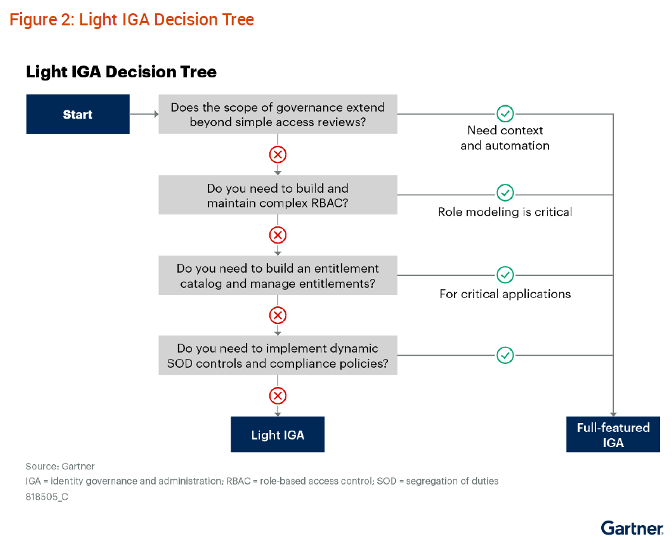
That’s precisely the question Gartner had in mind when creating its Light IGA Decision Tree.
It asks:
- Does the scope of governance extend beyond simple access reviews?
- Do you need to build and maintain complex role based access control (RBAC)?
- Do you need to build an entitlement catalog and manage entitlements?
- Do you need to implement dynamic Segregation of Duties (SoD) controls and compliance policies?
If you answer “yes” to any of these questions, Gartner says Light IGA won’t be enough. You need Full IGA.
If you answer “no” to all of these questions, then Light IGA might be sufficient.
On paper, the choice sounds clean and straight-forward.
Unfortunately, it’s not
Most Organizations Don’t Fit Neatly into Either Path
In practice, most organizations can’t answer all those questions definitively. Or they fall into a gray area, where their needs are moderate, their budget is constrained, and the stakes are high.
For example:
- A regional health provider may have multiple systems of record and legacy infrastructure, without any budget to invest in a million-dollar Full IGA rollout.
- A not-for-profit with Microsoft licensing might already have access to Entra ID Governance, but it needs better visibility into disconnected systems, OT and contractor access.
- A financial services team may be starting with Entra or Okta IGA, while planning to eventually move to SailPoint or Saviynt. However, that’s 18 months and three project phases away or, in fact, may never fully complete
In all these examples, the Gartner Light IGA Decision Tree points them toward Full IGA. Yet the reality is that the organization is not ready, under resourced, or unable to wait.
This is where both the challenge and the opportunity lie.
Light IGA Is Bundled But Leaves Gaps
Today’s Light IGA offerings are increasingly bundled into cloud ecosystems:
- Microsoft’s Entra ID Governance is included in enterprise licensing for many organizations.
- Okta Identity Governance is also being adopted, particularly among SaaS-first organizations.
- BeyondTrust, Ping, ForgeRock, and others offer lighter governance features tied to their broader platforms.
This bundling makes Light IGA more accessible, which is a definite win. The challenge is, it doesn’t make Light IGA a complete identity governance solution.
Most Light IGA tools accomplish:
- Basic provisioning (joiners, movers and leavers)
- Entitlement reviews for connected systems
- SaaS-focused lifecycle automation
- Integrations with modern cloud platforms
Most Light IGA tools are not built to encompass:
- Support for legacy, custom-built, disconnected and air-gapped systems
- Insights across multiple identity sources (like HR, contractors and physical access)
- Daily monitoring or access drift detection
- Segregation of Duties enforcement and toxic combination modeling
- Role mining, simulation, and advanced access analytics
This means many organizations that choose Light IGA eventually hit a hard wall. And the time between “quick win” and “growing risk” gets shorter.
What’s Missing from the Decision Tree? The Best Path
The Gartner Light IGA Decision Tree is valuable. However, it reflects a binary world: Light or Full.
The missing link is the “contextual layer” that can deliver immediate value, before Full IGA is funded, and far beyond what Light IGA is designed to handle.
This is precisely the challenge Gathid was built to solve.
Instead of replacing what you have, Gathid wraps around it:
- Enhancing Entra, Okta and other Light IGA tools with contextual, continuous insight
- Acting as a daily trust engine during the long rollout of Full IGA
Surfacing identity drift and access creep across all systems, whether they’re connected, custom-built, air-gapped, legacy, on-prem or in the cloud
Rather than forcing a one-or-the-other decision, Gathid enables organizations to see immediate results, while laying the foundation for long-term identity governance maturity.
Make the Tree Work for You
If you’re using Gartner’s Light IGA Decision Tree, it’s important not to view it as a verdict, but rather as a diagnostic tool. It can give you insights into what your identity ecosystem demands. But it shouldn’t lock you into one path or the other.
If you’re not ready for Full IGA, there’s no need to wait years to gain visibility or improve compliance.
If you’re starting with Light IGA, there’s no need to accept its limits.
And if you’re somewhere in between, you’re not alone.
Finally, a more effective approach is within reach.
In the next blog, we’ll take a closer look at where Light IGA delivers and where it may fall short. We’ll also explore how you can take proactive steps to avoid common pitfalls before they become problems.
More More from the Series